GET A QUOTE
The Standard

The discipline behind
every micron.

SPPF isn't sold to anyone who wants to install it. It's entrusted to specialists who've proven they can carry a standard that originated in Japan — and uphold it without supervision, without shortcuts, without compromise.

職人気質
Shokunin Kishitsu — The Craftsman's Spirit
The Philosophy

In Japan, quality
isn't inspected in.

Western manufacturing often relies on quality control at the end of a production line — catch the defect, fix it, move on. Japanese manufacturing philosophy operates differently. Quality is designed into the process itself. Every step, every hand movement, every measurement is part of an unbroken chain where excellence isn't audited retroactively — it's built in from the first moment.

This distinction matters because SPPF isn't a factory product. It's a hand-applied system. The quality of every application depends entirely on the person holding the spray gun. Which means the person matters more than the equipment — and how that person was trained matters more than anything.

"Transfer the discipline, not just the technique. If the technician understands why each step exists, they'll never skip one."

Three Japanese Principles
The cultural foundation
beneath every install.
  • 一
    Shokunin Kishitsu · 職人気質
    The craftsman's single-minded pursuit of mastery. Not perfection as a destination, but precision as a daily practice. Every SPPF technician is trained to treat each application as if it were the only one that mattered.
  • 二
    Kaizen · 改善
    Continuous improvement — never static. Techniques, formulations, and protocols evolve. What was best practice last year is baseline this year. Technicians don't just maintain a standard; they advance it.
  • 三
    Monozukuri · ものづくり
    The art of making things — a reverence for the entire process, not just the outcome. In SPPF, this means preparation is as valued as application, and curing is as precise as spraying.
Dealer Selection

Not everyone qualifies.
That's by design.

Before a dealer touches product, they pass through a multi-stage assessment that evaluates craftsmanship, facility readiness, technical expertise, and — critically — their willingness to be held to a standard they didn't set.

01 · Craftsmanship
Proven hands.
Not just promises.
We review existing work — paint correction, surface finishing, prior protection installs — to assess baseline skill, attention to detail, and consistency under production conditions.
  • ✓
    Portfolio review
    Prior work assessed for finish quality, edge detail, and surface consistency.
  • ✓
    Technique assessment
    Live evaluation of spray technique, correction methodology, and process discipline.
02 · Facility
The environment
is half the result.
A perfect spray technique means nothing in a dusty workshop. Facility standards are non-negotiable — controlled environments, proper filtration, precision lighting, and curing infrastructure.
  • ✓
    Spray booth audit
    Climate control, air filtration, dust management, and lighting to inspection-grade standards.
  • ✓
    Equipment verification
    Anest-Iwata™ spray systems, curing infrastructure, and measurement instruments confirmed.
Knowledge Transfer

Protocols from Japan.
Mastery built locally.

SPPF's training model mirrors the Japanese apprenticeship tradition. Protocols are developed by the original engineering team in Japan and transferred to local technical specialists through intensive hands-on instruction — not manuals, not videos, not distance learning.

The training covers product chemistry, surface science, spray dynamics, environmental variables, and quality verification. But more than technique, it transfers a mindset: the understanding that every micron matters, and that consistency across hundreds of applications is what separates a certified technician from someone who merely knows the steps.

Certification isn't granted based on attendance. It's granted based on demonstrated mastery — thickness uniformity, optical clarity, edge coverage, and cure integrity, all tested against published benchmarks.

Training Architecture
What certification
actually requires.
  • ✓
    Product Chemistry Theory
    How the formulation behaves — cure dynamics, adhesion mechanics, layer interaction, environmental sensitivity.
  • ✓
    Anest-Iwata™ System Mastery
    Not just operation — calibration, maintenance, nozzle selection, pressure tuning, and pattern control.
  • ✓
    Supervised Practical Application
    Multi-vehicle application under direct observation, with real-time correction and technique refinement.
  • ✓
    Pass/Fail Certification Testing
    Final assessment against SPPF's published quality benchmarks. No conditional passes. No grace marks.
  • ✓
    Ongoing Kaizen Cycle
    Annual recertification, technique updates, new formulation training, and network-wide quality audits.
The Instruments

A century of
spray gun precision.

Anest Iwata began in May 1926 as a small spray gun workshop in Yokohama, founded by brothers Hatsutaro and Sukezo Iwata. What started with two secondhand lathes grew into one of Japan's leading manufacturers of spray guns and air compressors, a company now in its hundredth year. SPPF technicians are certified on that same manufacturer's equipment.
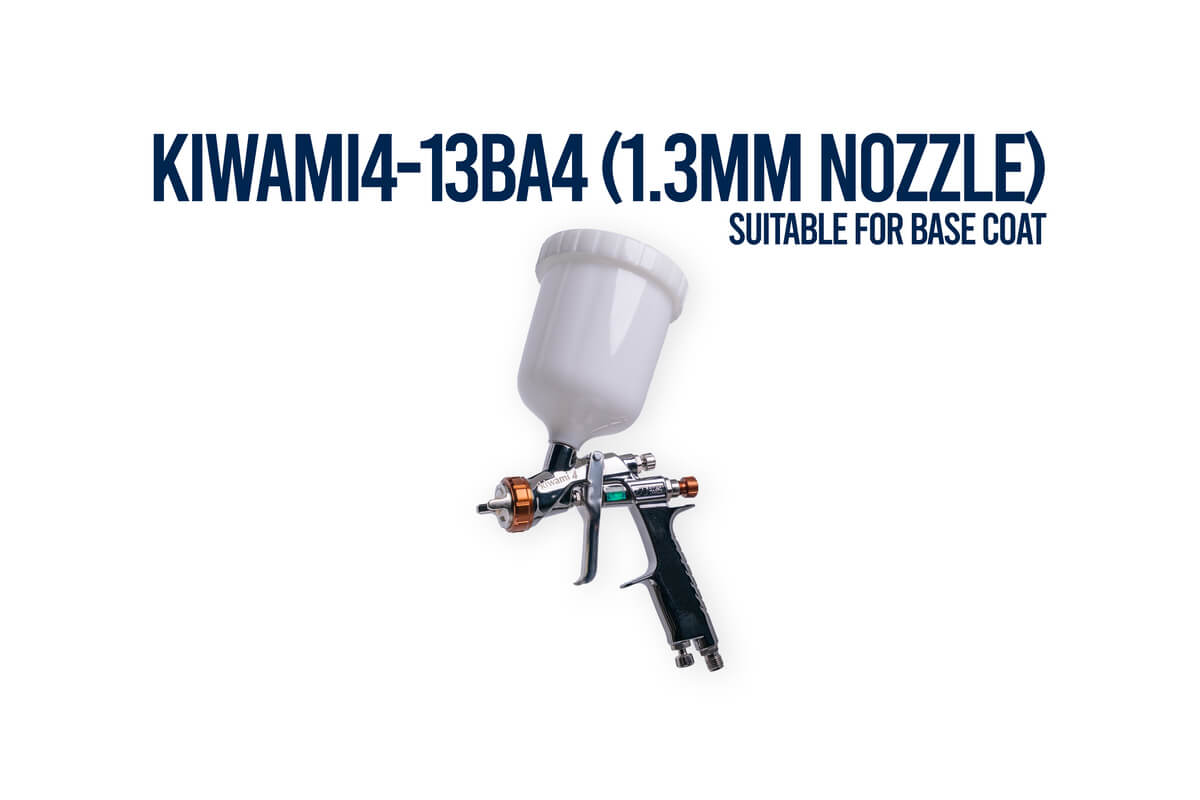
Anest Iwata Kiwami4-13BA4 gravity-feed spray gun
Base Coat & Clear Application
Kiwami4-13BA4
Anest Iwata · Gravity-feed spray gun
Feed typeGravity
Nozzle shapeStraight
Nozzle diameter1.3 mm
Air consumption270 L/min
Paint output220 ml/min
Pattern width280 mm
Weight (gun body)355 g
Compatible cups600 ml / 400 ml

Certified technicians are trained on calibration, nozzle selection, pressure tuning, and pattern control specific to this gun as part of Anest-Iwata™ System Mastery certification.
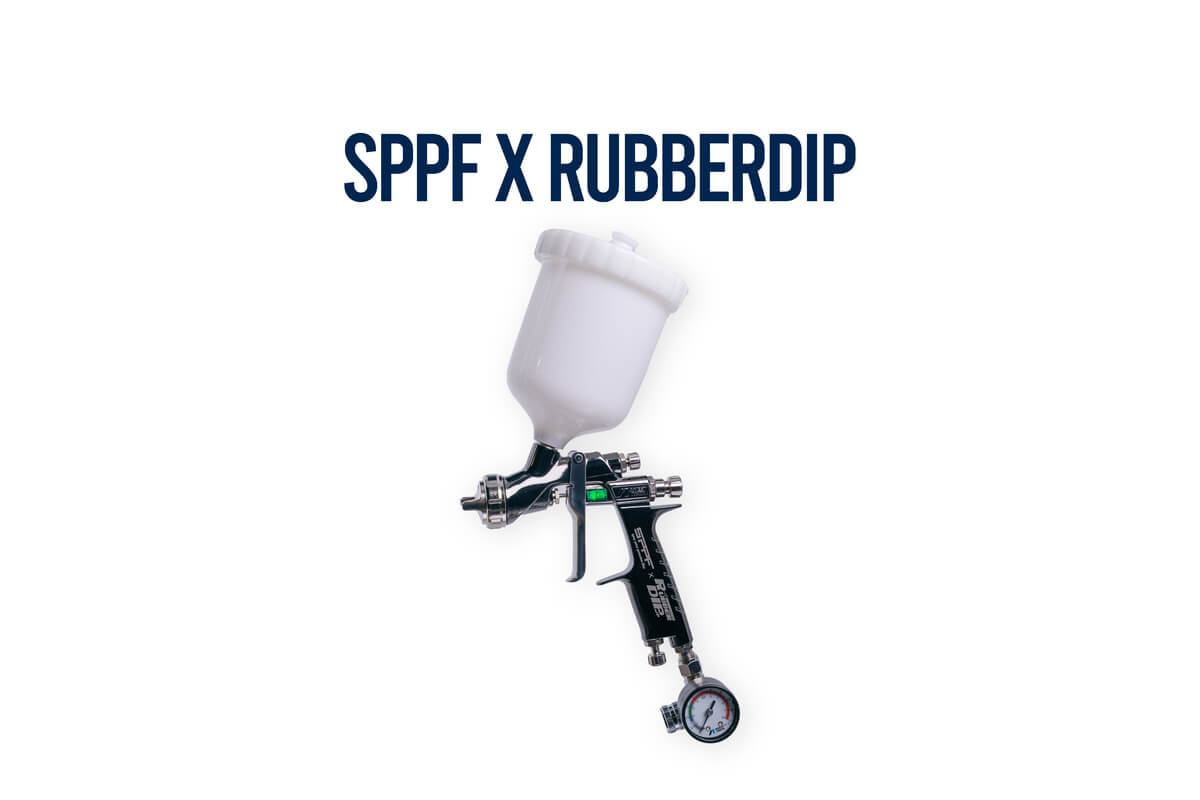
SPPF x RubberDip application gun
RubberDip & Colour Base
SPPF RubberDip Gun
Jetstroke · Purpose-built application gun

A separate gun, set up specifically for RubberDip and SPPF colour-base application, where spray behaviour differs from clearcoat work. Full specifications are being confirmed directly with Jetstroke ahead of publication.

The Benchmarks

The standard,
quantified.

100%
Japan-Origin Protocols
Every technique from source
職人
Shokunin Standard
Craftsman's pursuit of mastery
μm
Micron-Verified QC
Every application measured
改善
Kaizen Cycle
Continuous improvement
Your Car's Journey

Four phases.
One unbroken standard.

Every SPPF application — regardless of dealer, region, or vehicle — follows the same protocol developed by the Japanese engineering team.

1
Phase 01

Consultation & Scope

Paint condition assessment, coverage priorities, finish selection, and a detailed quote tailored to your vehicle, your driving pattern, and your long-term ownership goals.

2
Phase 02

Surface Preparation

Meticulous decontamination and paint correction under high-intensity inspection lighting. Every micro-imperfection is resolved before SPPF is applied — because the system seals in whatever exists beneath it.

3
Phase 03

Precision Application

Using an Anest-Iwata™ engineered spray system in a climate-controlled booth, SPPF is applied in progressive layers. No cutting, no stretching, no edges. The liquid film flows into every recess and across every contour your car's designers intended.

4
Phase 04

Curing, Inspection & Handover

Multi-point quality inspection verifies uniform thickness, optical clarity, and flawless finish against SPPF's published benchmarks.

Certified Partner · Malaysia
AutoDetailer Studio
No.89A – P2, Block H, Jaya One · 46200 Petaling Jaya, Selangor

Malaysia's exclusive certified SPPF applicator since the product's market introduction. Fully trained under Japan-origin protocols, operating a purpose-built facility to SPPF's global standards.

What's Next

Ready for the
Shokunin standard?

Every vehicle is assessed individually by certified SPPF specialists who carry the same discipline their training originated from. Your car deserves nothing less.