GET A QUOTE
Chapter 02 · Hyper-Flex Impact Absorption

Impact doesn't concentrate. It disperses.

Developed where failure isn't an option — the heat of motorsport. A molecular matrix engineered to absorb energy, not transmit it.

The Premise

Every stone chip tells the same story.
A point of failure.

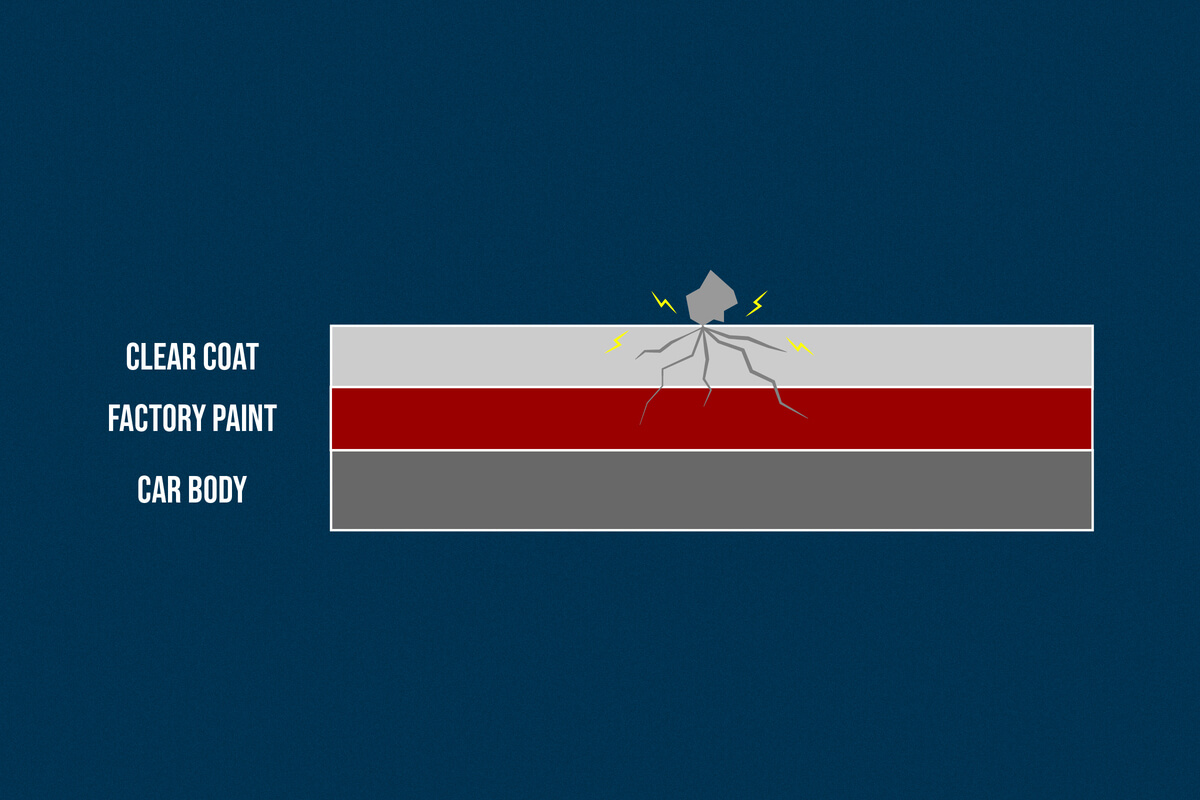
When debris strikes a painted surface, stress concentrates at a single point. The impact energy has nowhere to go — so it penetrates. Clearcoat fractures. Basecoat cracks. The damage radiates inward, not outward. Every stone chip is a small engineering failure.

Motorsport engineers solved this problem decades ago — for carbon fibre, for crash structures, for race-grade body panels. The principle is counter-intuitive: the best protection isn't the hardest material. It's the one that knows how to flex.

"The goal isn't to resist impact. It's to redistribute it."

5
Engineered Features
Working together as one system
2
Layers Above Your Paint
Hyper-Flex, then a renewable finish
0
Seams or Edges
Sprayed on, not laid over as sheet
1
Zone-Built Thickness
Reinforced where impact actually happens

A molecular lattice.
Engineered to flex.

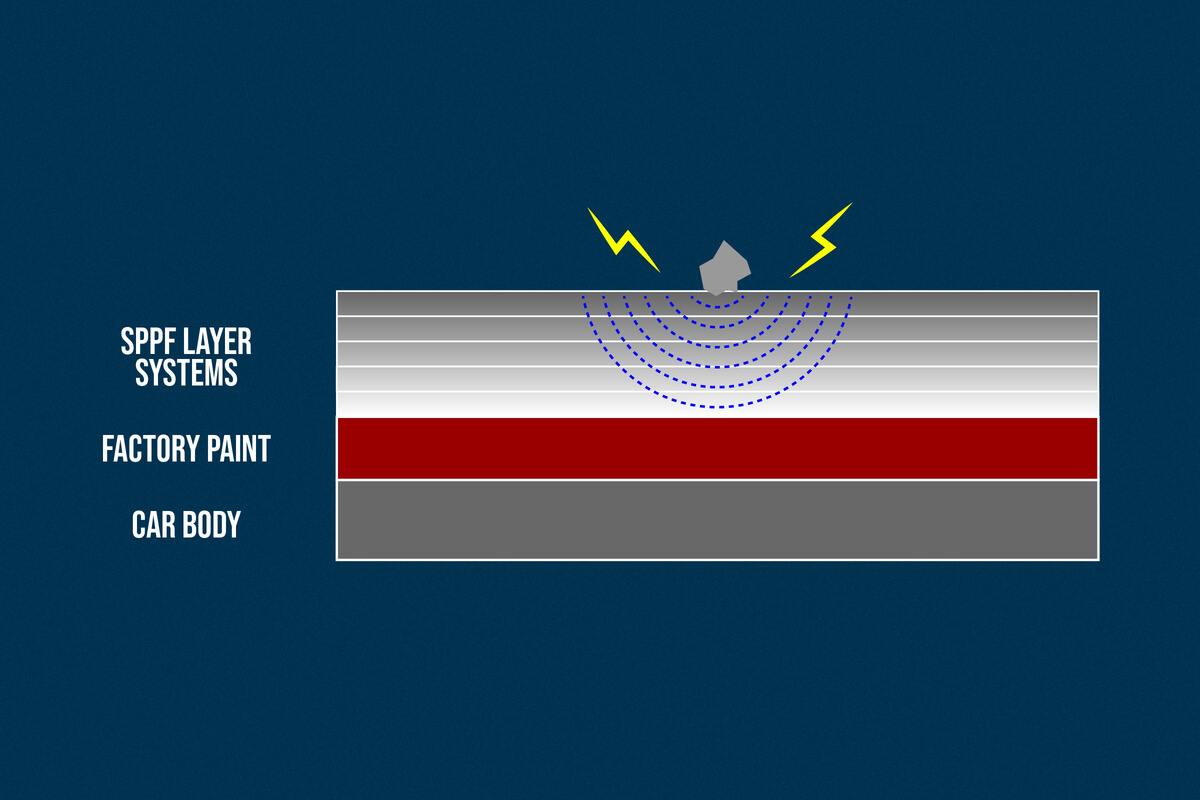
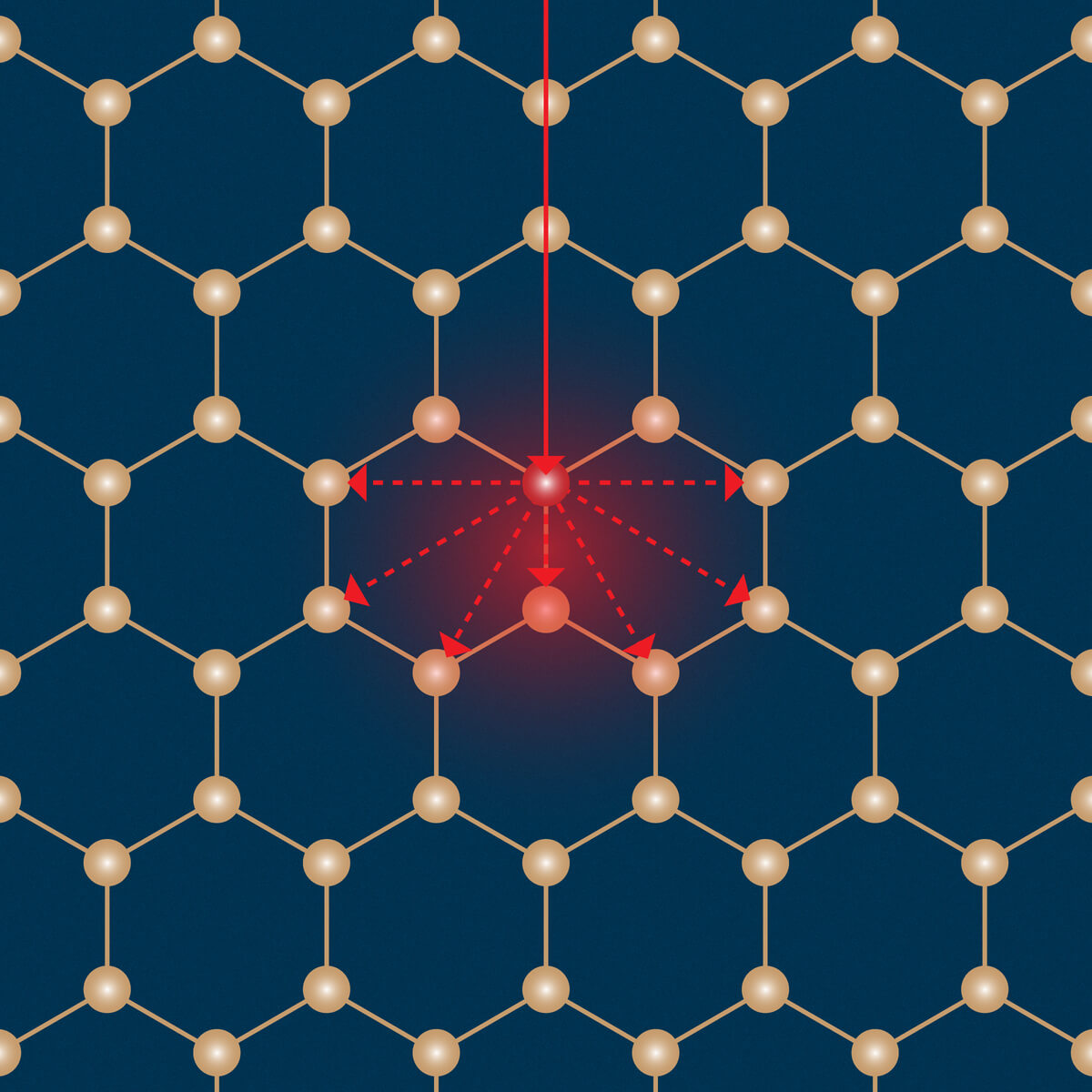
Hyper-Flex isn't a surface treatment. It's a cross-linked polymer matrix with directional elasticity — stiff enough to protect, flexible enough to absorb. When force arrives, neighbouring molecules share the load before it reaches your paint.

Cross-Linked Polymer Chains
Interlocked load-sharing structure
Primary matrix
Flex Nodes
Absorption & directional recovery
Impact zones
Elastic Memory Bonds
Shape-restoring molecular chains
Recovery system
Stress Distribution Channels
Force redirection pathways
Lateral dispersal
Hyper-Flex molecular lattice

Heat, sun and rain.
Every single day.

A car in Malaysia is worked harder by the weather than by the driver. The air sits above 30°C for most of the year, a dark bonnet left in open sun becomes too hot to rest your hand on, and an afternoon downpour cools that same panel within minutes. This cycle repeats almost daily, which is part of why paint here dulls sooner than paint in cooler countries.

  1. 01
    Sunlight is what fades paint
    Ultraviolet light breaks down the resins in clearcoat and the pigment beneath it, and heat speeds that process along. SPPF sits above your paint as a separate layer, so sunlight reaches the film before it reaches anything factory-applied.
  2. 02
    Rain here is not clean water
    Urban rain carries road grime, exhaust particles and whatever was already sitting on the panel. Left to dry in the sun, that mixture etches into clearcoat. With SPPF applied, the contact happens on the film surface instead.
  3. 03
    Panels move as they heat and cool
    Metal expands in the sun and contracts as it cools, and in this climate that happens most days of the year. SPPF is sprayed on and cures in place, so it forms to the panel rather than being laid over it as a pre-cut sheet.
ONE DAY, ONE BONNET
What your paint actually goes through
7 AM
Cool panel, overnight dew, and whatever dust settled on it while parked.
1 PM
Direct sun on an uncovered car park. The surface runs far hotter than the air around it, and ultraviolet exposure is at its strongest.
3 PM
A downpour drops the panel temperature quickly and leaves behind everything the rain was carrying.
5 PM
Sun returns and bakes those water spots onto the surface before you get back to the car.
DAILY
Repeat roughly three hundred times a year. This is the load SPPF is there to take instead of your paint.
Point vs. Surface

Same impact.
Different outcome.

The comparison below is an illustrative model rather than a laboratory result. It shows why spreading the same amount of energy across a wider area changes what happens to the paint.

Bare Paint · Concentrated

Stress at a single point

Bare paint: impact concentrated at a single point
Energy at impact~0.5 J
Contact areaA few mm²
ResultClearcoat fracture
RepairTouch-up or respray
SPPF · Dispersed

Stress across the matrix

SPPF: impact energy dispersed through the film
Energy at impact~0.5 J
Contact areaSpread through the film
ResultAbsorbed by the film
RepairSurface refresh

Where the bar
is set.

Racing environments set the benchmarks that consumer paint protection aspires to. High-speed debris. Extreme thermal cycling. Repeated impact events. Failure modes that would quietly compromise a street car get amplified at the circuit — which means every weakness surfaces fast.

"What survives motorsport usually thrives in daily use. What fails in motorsport would have failed on your car eventually — just more slowly."

Environment
Closed-circuit racing
Development and validation performed in competitive motorsport conditions where debris, heat, and sustained load intersect.
Failure Tolerance
Set by the worst day
A race team judges a material by the one session where everything goes wrong, not the twenty where nothing does. Ownership works the same way. You never think about paint protection on an ordinary drive to work, only on the morning a lorry ahead of you throws up gravel and you spend the rest of the journey wondering what the bonnet looks like.
Transfer
Road-ready by default
Every requirement that makes a material viable for motorsport automatically exceeds what a street car will ever demand of it.
What's Next

Hyper-Flex Impact Absorption
for how you drive.

Track day prep. Highway commuter. Weekend drives through rural Malaysia. Our certified specialists will scope the right Hyper-Flex coverage for your use case, vehicle, and threshold for paint anxiety.

← Chapter 01
Infinite Layer Technology
Protection that never starts over.